A small GPT that writes molecules.
MolGPT learns from 250,000 drug like molecules and writes new ones as SMILES strings. Ask for a range of logP and QED and it writes to match. Then explore what it invented as a network of similar molecules, in 2D and in 3D.
Version 0.1, an early release. More coming.
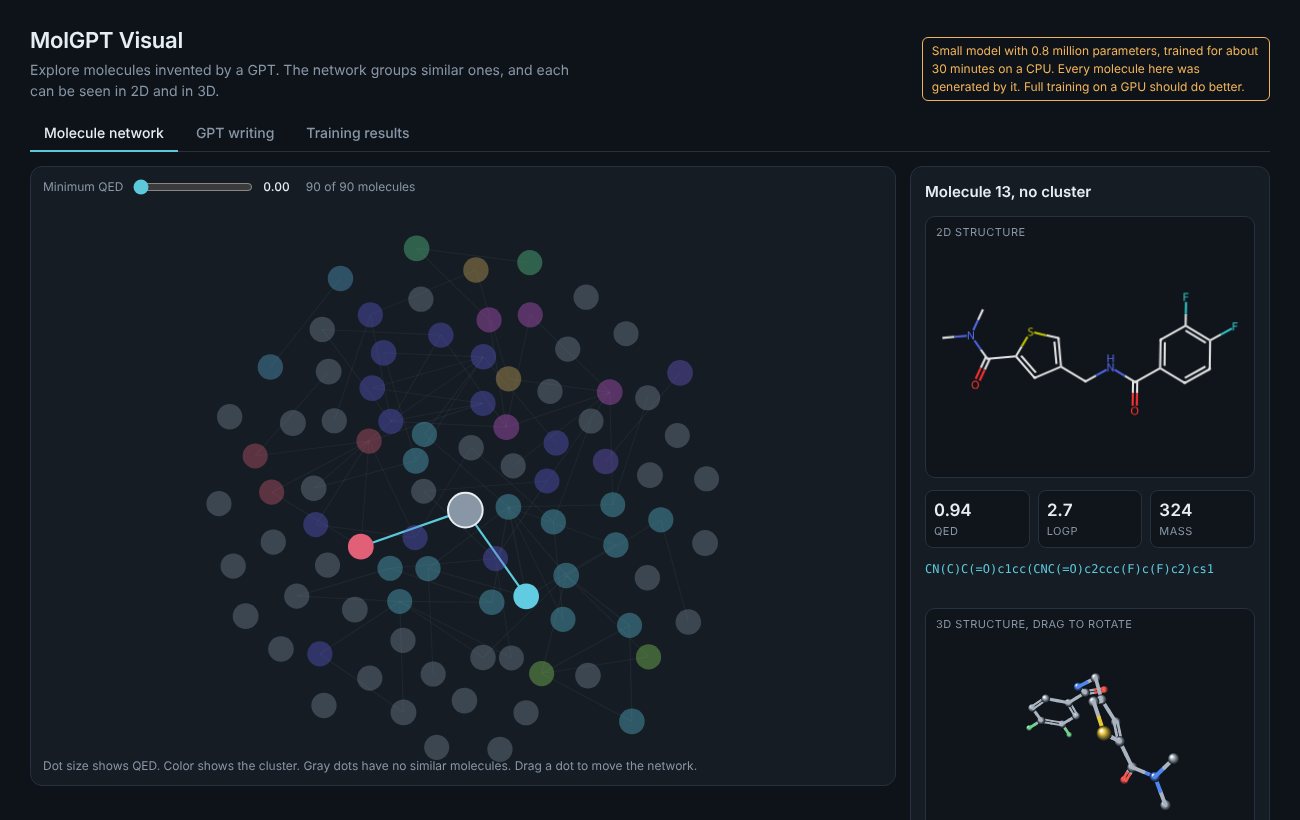
Watch it write, one piece at a time
The model writes a molecule token by token. Each piece carries a bar with the confidence the model had in that choice, and hovering shows the other options it considered. The recording comes straight from the trained model, and only the playback speed is artificial.
Try it in the interface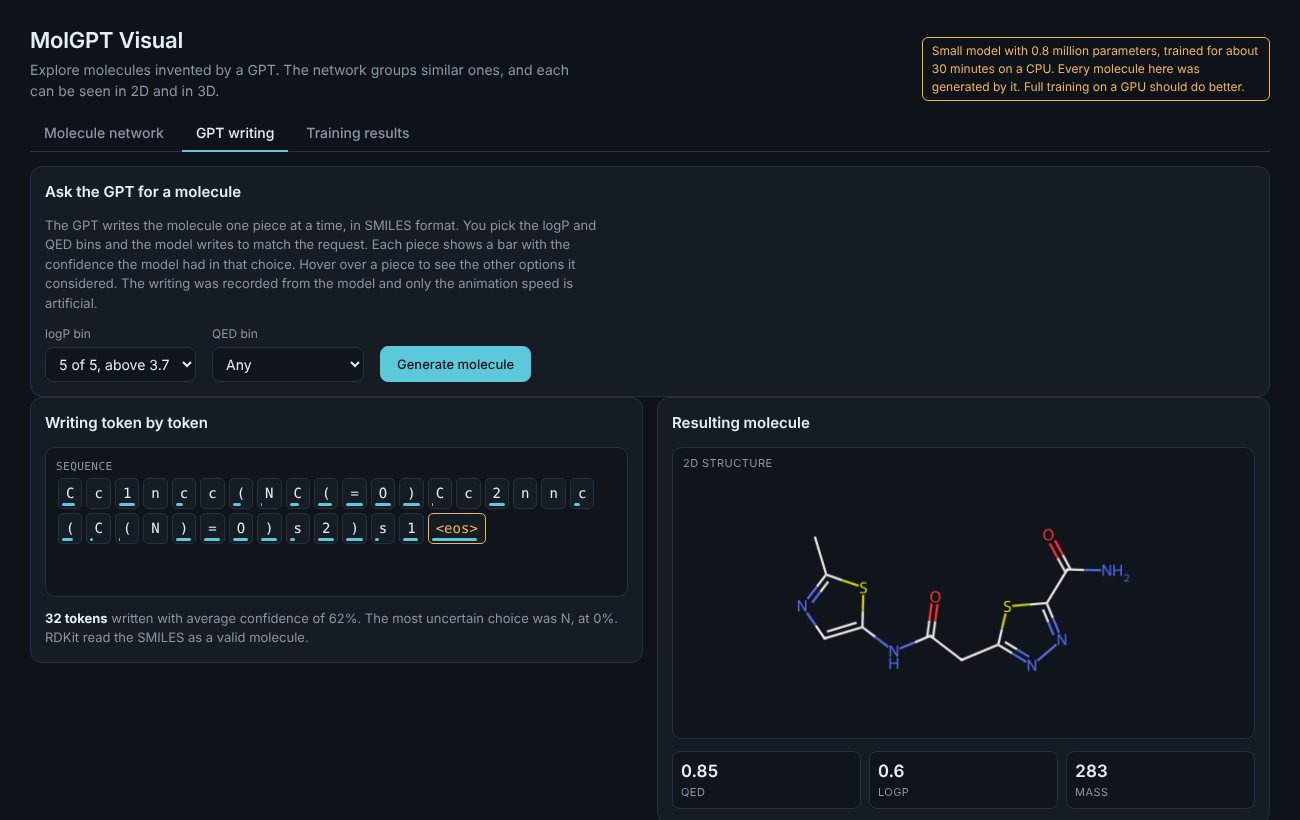
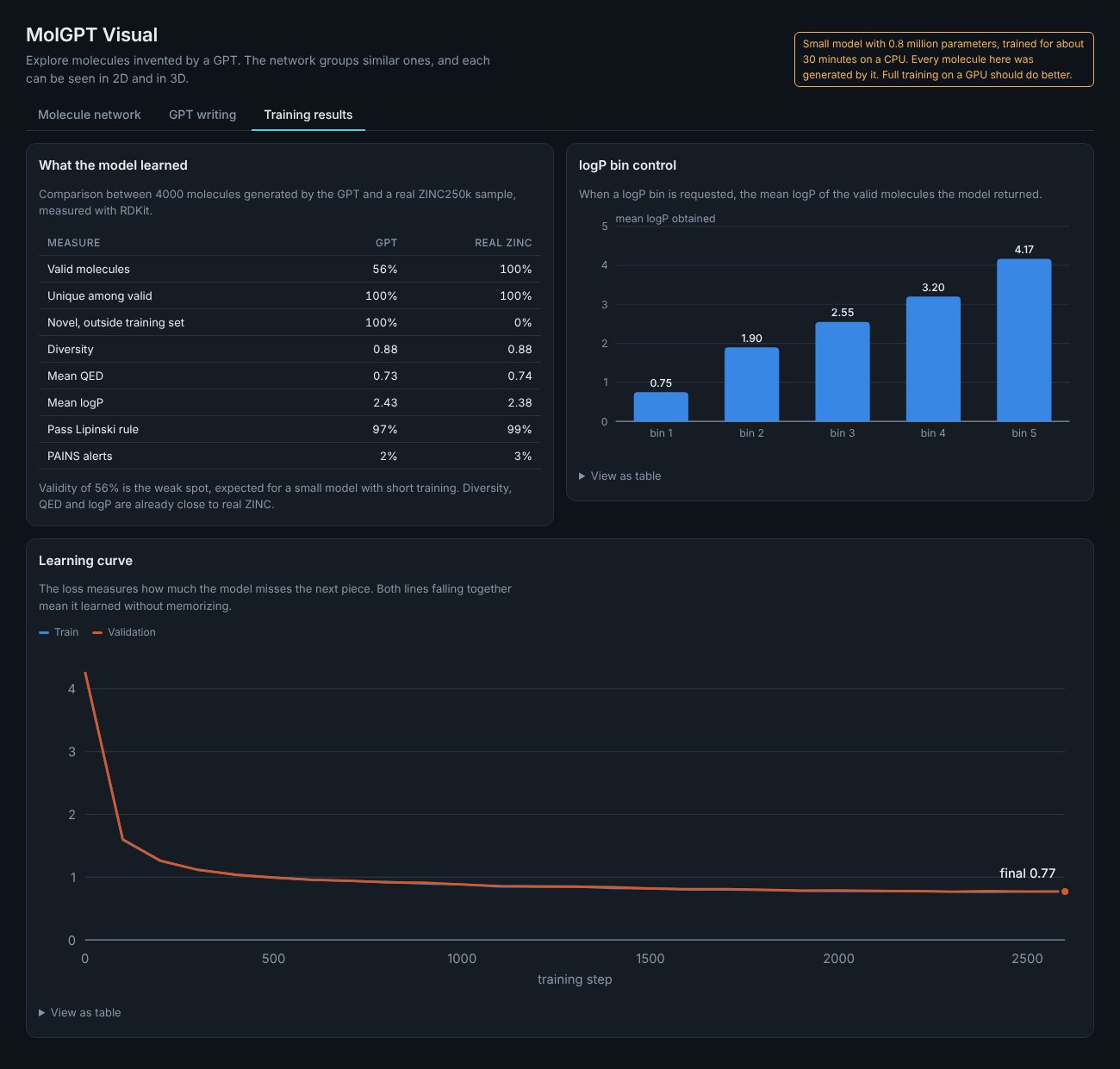
What the small model learned
A model with 0.8 million parameters, trained for about 28 minutes on a CPU. Numbers come from 4000 generated molecules compared with a real ZINC250k sample, measured with RDKit.
How it works
The pipeline is short on purpose, so every step is easy to read in the code.
- Tokenize every moleculeEach SMILES string is split into atoms, bonds and ring markers.
- Add two control tokensOne marks the logP bin and one marks the QED bin, so the model can be asked for a range.
- Train a GPT on the next tokenThe model sees a molecule so far and learns to predict the next piece.
- Generate and checkRDKit reads each result and keeps only the ones that are real molecules.
- Filter by drug likenessLipinski rules and PAINS alerts remove poor candidates before the visual step.
Run it yourself
The small preset trains on a laptop CPU in about half an hour. The full preset is meant for a GPU, for example a free Colab T4.
pip install rdkit torch pandas numpy matplotlib
python molgpt.py cpu     # small model, about 28 minutes on 2 CPU cores
python molgpt.py         # full model, meant for a GPU
MolGPT only knows the shape of drug like molecules from ZINC250k. It knows nothing about protein targets or binding affinity, so what it writes are starting candidates and not drugs. The next step is an affinity model, trained on public benchmarks, acting as a judge for the generated molecules.